
Six Things I’ve Learned About Plot and Story Structure from 20 Years of Freelance Writing
Lessons from a recovering plot-addict

Formula None (Alec Worley, 2026)
Logline
Biopic about a scruffy London gobshite obsessed with learning everything there is to know about plot structure. Unless he can tell a story within three acts (including a midpoint with a triple backflip), the world will never recognise his genius nor achieve lasting peace like it did in Bill and Ted.
Awards
Nine Oscar nominations, including ‘Most Amount of Money Spent on Screenwriting Books and Highlighter Pens’. Golden Globe: ‘Best Deranged Mosaic of Post-It Notes’. BAFTA: ‘Best Mental Breakdown’. FIFA Peace Award: ‘Being the Most Annoying Prick to Watch a Movie With ‘Cos They Keep Chipping In With Things Like, ‘Oooh, That’s Such a Clever Inversion of Freytag’s Pyramid’ or ‘Sorry, Can We Pause This? I Need to Write Something Down’.’
Beat-by-Beat Breakdown
The Ordinary World / Opening Image (Page 1)
Young Alec pores over the Operations Manual of West End Games’ Ghostbusters: A Frightfully Cheerful Roleplaying Game, his eye caught by a section entitled ‘Plotting the Adventure’.
“Any good adventure needs a plot. This sometimes scares novice GMs… It’s an arcane mystery to most people. But the fact is that plotting is simple… All you have to do is remember a few simple rules…
1.) Hero finds a goal.
2.) On the way to his goal, hero encounters a series of several problems, and, with effort, deals with them. Maybe he deals with them one by one; maybe he handles several at a time.
3.) Finally, hero encounters a Really Big problem.
4.) After much to-ing and fro-ing, hero finally overcomes the Really Big problem. This is called the climax.
5.) Hero achieves his goal (or learns why he doesn’t really want to, anyway).
And in the process, hero learns and grows.”
Ghostbusters: A Frightfully Cheerful Roleplaying Game (1986) by Sandy Petersen, Lynn Willis and Greg Stafford
Close on Alec’s acne-spattered face as he realises there’s a ‘proper’ way to write stories. And here he was losing himself in the joy of creative spontaneity like a sucker.
Alec eats some Pickled Onion Monster Munch and has a think. As opening scenes go it’s not as good as that bit with the monkeys in 2001: A Space Odyssey. But it’s what first got him thinking about story structure. So deal with it, yeah?
Catalyst / Call to Adventure / Theme an’ All That (Page 12)
Teenage Alec lies on his bed surrounded by posters of dragons and Winona Ryder. He’s reading from a stack of Michael Moorcock books, the sword-and-sorcery adventures of Elric of Melniboné, Prince Corum Jhaelen Irsei and Duke Dorian Hawkmoon, incarnations of the Eternal Champion, a heroic archetype that echoes across Moorcock’s multiverse like a less shit Doctor Who. Having read these books in rapid succession, Alec spots repetition with ease, the underlying similarities not just of character but of plot, almost as though the author were writing to a sacred formula.1
But more than that, Alec senses the leviathan of myth, an underlying presence whose wisdom has guided storytellers since antiquity, shaping the tales that made him, from The Lord of the Rings to Star Wars to the first Police Academy movie.
As high school comes to an end and a job at Blockbuster awaits, Alec sees a door open off to one side, revealing a world of narrative sorcery, whose arcane geometry may be understood by the dedicated, replicated, perhaps even mastered.
Alec’s eyes gleam like those of a Lovecraftian scholar who had to leave Miskatonic University because all the other seekers of forbidden knowledge thought he was a bit weird.
Refusal of the Call (Pages 12-25)
Over a year on the dole spent mainly in the foetal position, gibbering with terror at the realisation that he probably shouldn’t have spent all that time reading Ghost Rider comics instead of studying for his Maths exam. He clings to the delusion that destiny could still somehow intervene and anoint him Tooting’s answer to Quentin Tarantino. Alec wishes iPhone movie software had been invented and cries a bit more.
Break into Act Two (Page 25)
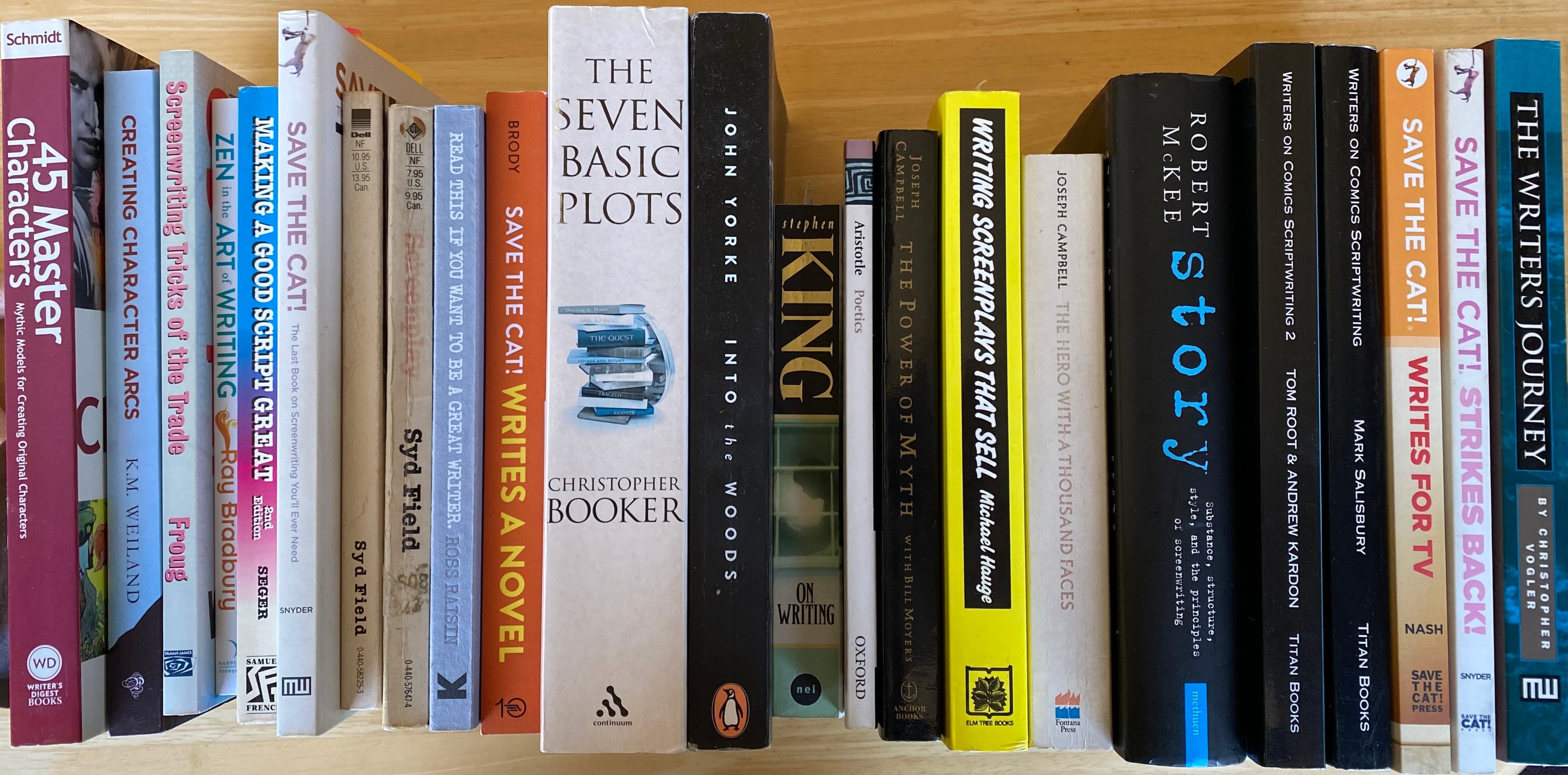
Alec thieves a copy of Syd Field’s Screenplay: The Foundations of Screenwriting (1979) from a local library. Not exactly his Save the Cat moment, but this is a Faustian inversion of the Fool Triumphant genre, so I’m sure it’s fine.
Meeting With the Mentor / B Story (Page 30)
Older now, Alec is gainfully employed as a cinema projectionist. Huddled in his eyrie at the Odeon Haymarket, absorbing the meditative chatter of the 35mm projector behind him, Alec communes with his ever-growing stack of how-to-write books.
Weirdly, almost all the books on fiction writing (most of them British) skip the chapter on plotting a story. They seem to treat the topic like something only a moron wouldn’t know already, or else something they were embarrassed to talk about, like an inbred cousin everyone agreed should be kept locked in the attic due to their enthusiasm for sharp objects and lack of bowel-control.
Alec finds American screenwriting books far more inclusive and sleeves-rolled-up practical. Christopher Vogler’s The Writer’s Journey (1992) is a CliffsNotes version of Joseph Campbell’s The Hero With a Thousand Faces (1949), a modern cornerstone of comparative mythology, which Alec gets through in three-hour chunks while running Titanic, pausing only for the occasional furtive peep into the auditorium at the 84-minute mark. (Please don’t ask why.) Syd Field’s follow-up The Screenwriter’s Workbook (1984) introduces the pivotal concept of a story’s ‘Midpoint’, while Robert McKee’s encyclopaedic Story (1997) dismantles 44,000 years of narrative tradition with the efficiency of an F1 mechanic.

Midpoint (Page 203?)
His brain bulked up with narrative knowledge from many years of study, Alec makes his first professional sale of an original story in 2007, to legendary British comics anthology 2000 AD. But he’s been working in movie journalism since the making-of piece he wrote on The Evil Dead for Shivers magazine back in 2000, followed by several years of movie journalism, which was pretty much a Dark Night of the Soul and he doesn’t remember ever Seizing a Sword (though very often felt like it).
The Next Bit / the Final Duel / The Last Bus Home / All That Stuff (Page Whatever)
Knocking on almost twenty years of story-writing in the worlds of Star Wars, Judge Dredd, Teenage Mutant Ninja Turtles, Warhammer and all the other trophy-brands he needs to crow about to keep his freelance career afloat, Alec’s compulsion for story-structure has mellowed, though he remains fearful of missing out on the next storytelling trend, the one that might… just MIGHT provide the final piece of the puzzle.
He’s compiled acres of notes from years of listening to precious, snake-oil-free podcasts like John August and Craig Mazin’s Scriptnotes and The Q&A with Jeff Goldsmith (both 2011- ), then Blake Snyder’s Save the Cat (2005) gains popularity, its undeniable usefulness tempered somewhat by its pyramid-scheme energy.
John Yorke’s Into The Woods (2014) knows the score, while Christopher Booker’s behemoth The Seven Basic Plots (2004) proves unwieldy, though everyone working in comics at the time seems to be chasing Dan Harmon’s Story Circle, before the even cooler kids began espousing the East Asian Kishōtenketsu tradition, and author Dan Wells started trending with his Seven-Point Story Structure. Or was it Six? Or 29?
Alec presses on, unwilling to let go, forever chasing that mythical revelation where he’ll finally comprehend the matrix of Story and wow his readers with feats of narrative kung fu.
He can see that Holy Grail teetering on the abyss, if he can only… just… reeeeach it…
1.) Story Formulas Can Be Addictive; Know When to Stop
Story formulas, whether it’s the Hero’s Journey, the Heroine’s Journey (by Maureen Murdock), Vladimir Propp’s 31 Narrative Functions, etc., are all presented (usually sold) as products of the author’s experience, whether that experience is served-in-the-trenches practical or entirely academic. They are distillations of hard-won wisdom, gained at the resolution of an author’s own hero-journey and imparted to you, the future traveller.
The mystery of a new story formula is alluring, even more so their promise of a solution to the turmoil often felt by writers. Every new formula feels gift-wrapped, contained, calm, conclusive. No gnawing doubt or indecision here, the only survival kit you’ll ever need on the road to working out a plot now and forevermore.
To any writer with a natural thirst for knowledge, it’s an irresistible package deal. But pain and hunger can make you careless, open you up to gurus and grifters who want to fool you into thinking you can come up with a story just by typing in a prompt or filling in a form.
The promise of avoiding hard work, the banishment of fear and the achievement of permanent clarity is what keeps story-structure addicts forever chasing the big score.
Maybe THIS formula will shed some light on all that stuff in the last one that I struggled with. Dammit, I NEED this book! No, lemme take the 24-week course instead. Where’s my credit card...?
It’s much healthier to study story-structure one step at a time, like someone studying a map in preparation for a hike, then going on that hike, trusting they’ll do their best not to get lost while accepting they’ll almost certainly make a few wrong turns. The story-structure addict is the crazy person obsessed with studying every map of every hike they’re ever likely to take between now and the day they die. But never going on ANY hike because they were too busy studying.
Compulsive overstudy creates anxiety, overthinking, paralysis by analysis; you’re too scared of getting it wrong to ever have a go at actually doing it, at simply listening to your story and then telling it. Or else the addict clings so tightly to the training wheels of formula that they never give their own voice, their own experience room to fly.

If you’re starting from scratch and have no idea about story structure, John Yorke’s book Into the Woods: A Five Act Journey into Story is a great starting point. It’s wide-ranging, practical and applicable. Study it, make notes, then put it aside and take a pass at plotting your story before filling your head to overflowing with yet more expert advice.
Study, apply, study, apply.
Not studystudystudystudy.
I’ve found that experienced writers don’t cling like cultists to any one story theory, but rather formulate an individual homebrew of their own, based on bits and pieces of different theories, along with lessons learned from mistakes made.
Take what works for you, chuck the rest. Build your own formula.
But remember, even if a book were to be written that contains a unified theory of all story-structure in the universe EVER, it would still only be half the journey to understanding how stories are actually plotted.
2.) Embrace the Abyss
Story structure and its myriad plot formulas appeal most of all to young and/or inexperienced writers because they appear to offer a bridge across the seemingly unknowable chasm of a story yet to be written.
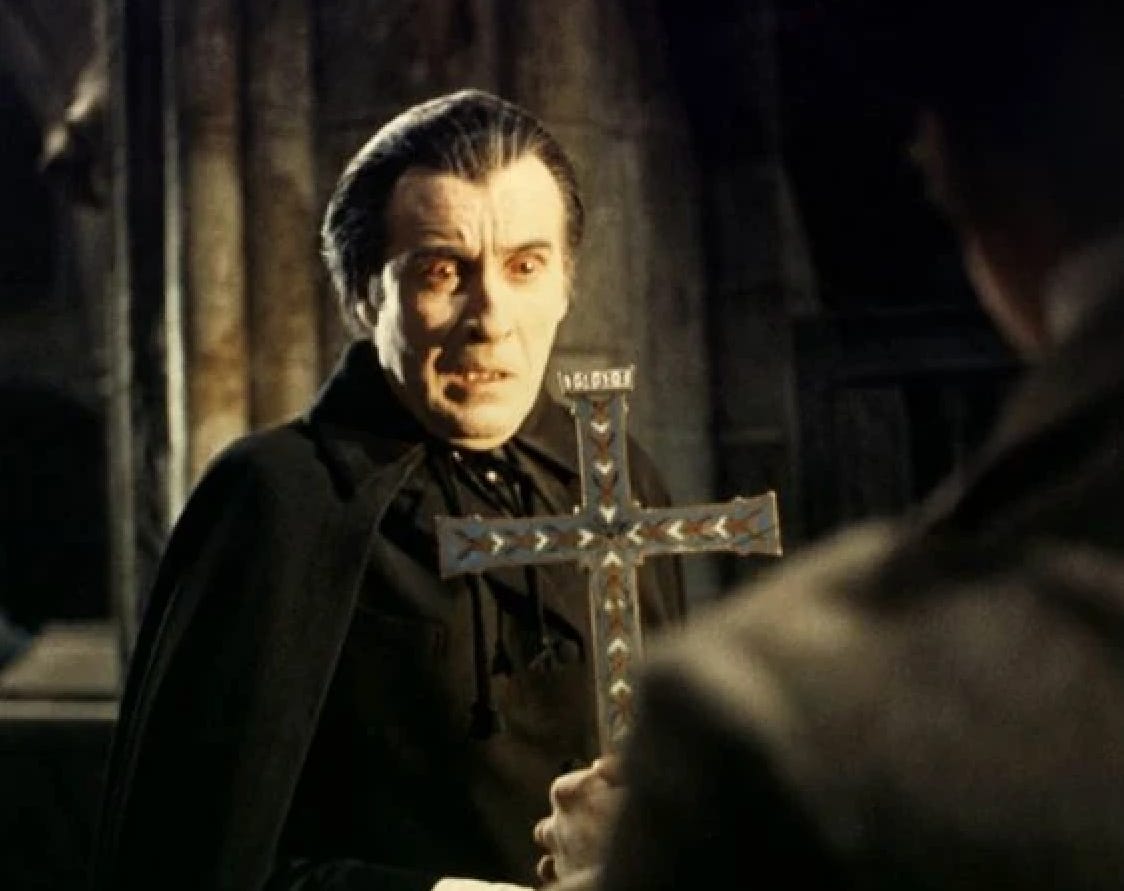
In truth, story formula can be more like a crucifix warding off the vampire of self-doubt.
Addiction to story-structure theories or an overprescription to their formulas stems from a fear of failure, itself the fear of shame at having failed.
This anxious thinking goes that, since your story came from you, if the story fails then you have failed too, as an artist, as a human being. The resulting feeling of shame is so corrosive, poses such an existential psychological threat that writers will sabotage themselves without even realising, just to keep themselves ‘safe’.
This is called ‘procrastination’, of which clinging to story structure is just another form. (Steven Pressfield’s dynamite book The War of Art [2002] explains how to punch this unconscious self-sabotage in the face.) It’s just another sneaky way in which we keep ourselves from the risky act of writing or plotting a story.
We cling because we don’t believe we’ve learned enough, that WE’RE not enough. Story formulas appear complete and perfect in a way our brains will never be. We may have a few published stories to our credit, but we’ll tell ourselves our instincts can’t yet be relied upon to keep us from stumbling into the abyss.
The truth is, as with all other aspects of writing, failure is part of the process when it comes to plotting the events within your given structure. It’s the messy, human half of the job, the bit that no textbook or story-course can ever cover. The map of the screenwriting manual must be set aside and the writer must plunge into the thickets of their own creativity.
We stake so much of ourselves on a successful outcome to that mission, it’s no wonder many writers get stopped in their tracks.
This is why so many advocate ‘fail fast, fail early’ when it comes to a first draft. Give yourself license to write that unbearably awful version of your story. Produce the raw material. Give yourself something to work with. You can’t sculpt a fancy vase until you’ve dumped an ugly heap of clay onto your potter’s wheel.
Plotting (whether it’s something you work out beforehand or whether you go in blind and develop it over the course of successive drafts) is as much about figuring out what your story isn’t as what your story is.
Hitting a dead-end is actually progress, as it narrows down your story’s routes to a plot-point that WILL work, helping define a clearer route to your next breakthrough.
If you feel too lost in fear to make it through the wildwoods, take a time-out and define what it is you’re afraid of. Write down exactly how you think you’re going to screw this up. Go deep. Who do you think you’re letting down? How won’t you measure up? How much do you feel you have riding on success? Talk to people who share the same experience.
Bringing these fears to the surface won’t banish them, but it will make you more aware of them and therefore make the sneaky little bastards less likely to poke holes in your confidence without you noticing.
Story structure and plot formulas promise control, but it’s a control that must be balanced by a degree of chaos.
Turmoil and uncertainty are unavoidable. So bring it on!
Crash, burn and learn.
If you’re enjoying this post, thank my paid subs and contributors!
Having set aside every donation received by Agent of Weird via Substack and Buy Me a Coffee since last year, those donations have now gone to cover me for one of the days I took away from paid work to write this post.
I want those generous few to feel like their contributions have gone towards helping bring something useful into the world, and provide a tangible benefit to their fellow readers, writers, connoisseurs and creators.
Thanks to everyone who has shared, recommended or subscribed to Agent of Weird: Exploring the Write Fantastic!
Every drop of reader-support is helping this project grow.
3.) Be Water, My Friend
Put all your favourite story formulas in a row, stand back, squint a bit…
All look kinda the same, don’t they?
The bits that stand out are the broadest principles: the acts, the overall arc. These remain the most applicable to the story you have in mind simply because they are the vaguest and therefore offer the most space for writerly interpretation.
Plot formulas are too detailed, often ludicrously prescriptive, to be universally applied. Apply three different plot formulas to Die Hard and you’ll get three different interpretations of where the midpoint lands.
When putting together an outline for a story, I tend to think in terms of two act breaks and a midpoint, the general flow of each section in between, and that’s pretty much it. I try and meet the story halfway, rather than bully it into complying with a prearranged sequence.
Broad principles work for me because they’re easy to carry in my head without losing flow. Trying to distinguish whether the beat I’m creating is a ‘Dark Night of the Soul’ or a ‘Bad Guys Close In’ moment slows me down, crams my brain, creates anxiety.
I try and let that beat of the story be what it wants to be. Let it exist first. I can make editorial judgements and whack a label on it – if at all – later.
There is no ‘correct’ at this point; don’t get it right get it written.
Similarly, there’s no need to fuss over the ‘correct’ route to plotting a story.
“I often talk about writers and I say that there are two types. There are the architects, who plan a whole book out ahead of time, just as an architect designs a building, and they know where the pipes run, and how many rooms there are, the square footage of each room, the elevation, etc. They know everything about the house before they even buy a single piece of lumber or drive a single nail. And then actually building the house is just putting the plan into execution.
On the other hand, there’s the gardener. And the gardener sort of digs a hole and throws in a seed and waters it, and tends what comes up, and shapes it and prunes it. Now the gardener isn’t completely ignorant. The gardener knows what he’s planted, whether it’s an elm tree or a weed, but he has a lot less control than the architect, and he doesn’t know how the final tree is going to work.
I think all writers are part architect, part gardener, but the proportion is different. I’m much more of a gardener than I am an architect, and many of the writers that I admire and enjoy I think are gardeners too – Tolkien, I think, is a classic example.
You have to know certain things before you set out. You have to know what you’re planting, what the final destination is and what the ending is. And major twists and turns or developments in the plot like the Red Wedding, you know about them ahead of time. But you don’t know what’s gonna be on every page, or what’s going to happen to every minor character. Some of that you discover in the process of writing, during the journey if you will, and that’s the fun part, for me, about writing.”
George R. R. Martin (SFX magazine, 2012)
Plotters, pantsers, the internet will have you believe it’s one or the other. Really, it’s a spectrum of preference based on confidence, experience, and – more than anything – the practical constraints involved in writing the story.
Do you have any stakeholders? Have they got you on a deadline? Are you getting paid? In the world of commercial writing (screenplays, comic books, franchise-fiction), producers and editors need to know what they’re buying into or why you feel Spider-Man marrying the Vulture might be a good idea.
The bankrollers need a separate document that describes your proposed story in its entirety, a synopsis or ‘treatment’ (I’ve taken to calling them ‘breakdowns’). Commercial plot formulas are specifically designed to help you produce that document.
Save the Cat has become probably the most successful screenwriting formula of all time. It’s a bible not only for writers, but also development execs, who now get to join in rooting out the heresy of screenplays that don’t conform to scripture.
Years of breakdown writing has turned me into a habitual plotter. Once I’ve figured out a story, I’ll transcribe that string of notes into a single coherent breakdown, one that errs on the side of detail, but is related in a sexy, pitching-to-the-room style, enlivened with snatches of dialogue, etc.
Experience has taught me that it’s a good idea to explain exactly how a story is going to work, ensuring the editor, the license-holder and me are all on the same page. This way, potential issues regarding continuity, budget, lore, story logic, etc. can all get flagged early on. Let’s make those changes while those changes are still easy to make. Extensive structural amends require tearing up the carpet of your script to reconfigure pipes and floorboards, which takes up lots of time and eats into a freelancer’s precious margin like a xenomorph’s nosebleed.
I’ve found prose writers tend to be more pants-y, as they have fewer such constraints (certainly from the outset, before an agent or publisher gets hold of their manuscript) and more freedom to explore and experiment.
“PLOT OF EVERY BOOK EVER: Someone is looking for something. COMMERCIAL VERSION: They find it. LITERARY VERSION: They don’t find it.”
Author Matt Haig, 2013
Flexibility is also required when it comes to plotting at scale.
A three-minute short film and a 24-episode series may contain the same overall beginning-middle-end structure, but the beats of the plot within that structure differ greatly in size. A pivotal no-turning-back-now midpoint might be conveyed with a single line of dialogue in a short film but cover three whole episodes in a series.
John Yorke covers this perspective in Within the Woods, but I’m rather chuffed to have realised this before I read him, and that’s that plotting comes with a zoom-button.
The overall structure of a story is most apparent when you zoom out and view that story in its entirety, but when you zoom in on a single scene that same underlying structure remains visible but on a smaller, more immediate scale.
As Yorke puts it, stories are ‘fractal’.
To boil all drama down to its bones: your focal character wants something (line of action), but something or someone stands in their way (counter-action), and something terrible will happen unless the focal character achieves their goal (stakes). This paradigm applies to both the overall story and the individual scene.
Over the entire 682 minutes of Peter Jackson’s The Lord of the Rings trilogy (Yes, I only watch the Extended Editions because I’m not an animal), Frodo must destroy the One Ring in the fires of Mount Doom (line of action) but must travel across the continent of Middle-earth where the forces of Sauron are arrayed against him (counter-action). Should he fail, all of Middle-earth shall fall (stakes).
Now zoom in on that scene in Fellowship of the Ring where the hobbits have just arrived at the Prancing Pony. Frodo needs to sit tight, wait for Gandalf and remain incognito (line of action). But he’s been told by the innkeeper that Gandalf may not be coming, the locals (among them a dangerous-looking ranger) are already giving the hobbits suspicious looks, while the Ring whispers, ever whispers… and Frodo’s blabbermouth cousin has just discovered that beer comes in pints (loads of counter-action here). If Frodo’s cover is blown, if he succumbs to temptation and slips on the Ring, his secret mission will go public and he’ll reveal the hobbits’ position to the pursuing Nazgul (stakes).
Overall story, single scene. As above, so below.
I’ve learned that when tackling structure and plotting, it’s best to stay loose and manoeuvrable. Think principles applied flexibly, not rules applied rigidly.

4.) Breakdowns Prevent Breakdowns (and, No, Plotting Beforehand Doesn’t Kill Your Spontaneity)
I’ve learned that writing is all about flow, whether I’m mapping a plot or writing an actual draft. Breakdowns help me maintain that flow.
Getting the majority of my story problems out the way before I begin writing allows the writing itself as smooth a passage as possible, because I no longer have to worry about the bigger-picture stuff. I know (for now) who the characters are and I know in which direction I’m heading, which frees me up to focus on the scene and get the most out of it.
When a breakdown fails to patch a hole in my characters, story logic or fantasy mechanics, those holes will sink my story-ship mid-voyage, forcing me to down sails and start bailing as I consult my breakdown or – if those narrative leaks are really bad – paddle back to port, where I’ll haggle with the editing side of my brain and commence time-consuming repairs.
Sometimes you just get stuck in a scene. You can’t see the woods because of all these stupid trees. Your flow turns to glue. Your momentum sinks. Anxiousness whispers like the One Ring. I told you this was no good! This isn’t going to work. That deadline’s getting closer…
Being aware of story structure and having at least a plausible idea of the sequence of beats that make up your plot provides a map that can help keep you on point and those whispers at bay.
“When you’re writing a screenplay, you have no objectivity at all – no overview. You can’t see anything except the scene you’re writing, the scene you’ve written, and the scene you’re going to write. Sometimes you can’t even see that.
It’s like climbing a mountain. When you’re moving toward the top, all you see is the rock directly in front of you, and the one above you. Only when you reach the top can you gaze at the panorama below.
The hardest thing about writing is knowing what to write. When you’re writing a screenplay you have to know where you’re going; you have to have a direction – a line of development leading to the resolution, the ending. If you don’t you’re in trouble. It’s very easy to get lost within the maze of your own creation.”
Syd Field (Screenplay: The Foundations of Screenwriting, 1979)
Yes, yes, I know that sounds prescriptive, but the crucial factor here is the degree of detail you apply to your plan from the outset.
Don’t add too much!
I’ll plan the general direction of a scene, what kinda needs to happen, the pivot the characters are most likely to make. Nothing’s set in stone. I still don’t know how those characters are going to react until I come to write the scene. Once I’m in there with them, I might spot a potentially interesting detail – a prop, a sideline character – which I can then bring into play. I might realise an emotional significance the setting would have for a certain character, something that stirs memories, makes them throw a punch instead of make nice.
If the scene wants to go in an unexpected direction, I let it. The story knows better than me. If that cool detour affects the overall beats I had planned, I let it.
The breakdown is just a starting point. It isn’t chiselled on stone tablets.
It’s a draft zero.2

5.) Plot Formulas Don’t Really Help Until AFTER You’ve Finished Plotting
“A book grows according to a subtle and deep-laid plan.
At the end, I see what the plan was.”
Hilary Mantel (The Guardian, 2012)
Plotting and drafting require a certain back-to-front thinking. You’re trying to apprehend the invisible, seeing something that doesn’t yet exist. Not in this world, anyway. Your task then is to pierce the veil and usher that something into the reality of our world, preferably in one piece, and all the while hoping you’re not summoning some cosmic abomination that will demolish your career.
“In every block of marble I see a statue as plain as though it stood before me, shaped and perfect in attitude and action. I have only to hew away the rough walls that imprison the lovely apparition to reveal it to the other eyes as mine see it.”
Attributed to Michelangelo (not the turtle)
Pixar writer/director Andrew Stanton has called writing a screenplay, “making movies by braille”. You’re figuring out the plot with a degree of blindness, constantly defining what the hell the story is as you go along.
“I’m a complete believer that you discover the story, that it’s buried somewhere and you’re just uncovering it. – You basically say, I’m pretty sure that the idea of what we wanna make is in the ground HERE. It’s these dinosaur bones somewhere down here, and I’m not sure what kind of dinosaur it is. I THINK I know. We’re gonna say it’s a Tyrannosaurus Rex. And you start digging, but you have no control over what bones are gonna come up first. To think you do is a waste of time. What you CAN control is how fast you can dig and how quickly you can get the bones up, but you have no control over what bones they are or whether you can identify them right away. Just start digging.”
Andrew Stanton (The Q&A with Jeff Goldsmith, 2010)
“It’s kinda like an archaeological dig. Like the story already exists and you’re discovering it. It’s not like you’re creating it… It’s like you’re a person in a room with the lights out.”
Amanda Silver, screenwriter, Dawn of The Planet of The Apes (The Q&A with Jeff Goldsmith, 2011)
This sensory, predictive approach is why plot formulas don’t often work as sold.
They cannot be applied like Microsoft Excel. You can’t identify the beats of your story until you’ve done the hard work of pulling them out of your head and figuring out how they connect to all the other beats.
No plot formula survives first contact with your story. So when the great invisible dragon of an unwritten tale wheels in your direction, ready to blast your self-esteem to cinders, you can plan your first step of attack, but that’s about it.
Beyond that, you’ll need to get by on instinct, guts and endurance. This is why many writers advocate having at least some idea of an ending in mind beforehand, as it gives you an approximate destination and stops you wandering miles off-course.
Stay fast, stay loose, save details for later. Put stray ideas, thoughts and notes aside for now. Getting too detailed too soon is like trying to decorate a house that hasn’t yet been built. You don’t even know yet whether you’re working with bricks, straw or cow-poop. Everything is in flux.
Zoom out a little and write a crazy scribble-draft of how you think the whole story will pan out. Give yourself something to work with, a framework, then zoom back into the scene.
Or start with your ending and work your way backwards.
Or start with your backstory, maybe the events of the mystery your story will gradually uncover.
Once you’ve got a secure grip on something, anything, a scene, a character, a moment, you can start thinking through the story/character logic of that something as it exists within the story. Could this happen? Would this happen? Only stop to peek at your how-to books if you get stuck, then put those books back on the shelf.
Thinking through what you have will reveal cracks, flaws and absences you’ll need to repair before you can proceed. Once you’re confident you have something, build another act, another beat, another scene. It doesn’t need to connect to this one. You can just give yourself another point further down the line to work towards. Keep thinking through, fixing, connecting the dots, until you can feel the overall shape of the story coalescing in your head.
The trick to progressing a plot is to gradually move from the general to the specific, from overall structure, to emotional arcs, to specific scenes.
Writing longhand notes helps me figure out specific questions: Okay, so how do these magical thingamajigs actually work? Okay, but why is Hironimus so angry at his mother? Okay, but, as a psychic, how does Lydia Farthought actually perceive the world around her? Writing answers in longhand gives me a thread to follow backwards and highlight the bits I need. Talking out loud to myself is great, but it’s easy to lose track of your thinking and end up rambling like a nutter.
Plotting (or ‘breaking the story’ as it’s sometimes called) is like making your way along a Snakes and Ladders board: five steps back, two steps forward, one step back, seven steps forward.
It’s chaotic in four dimensions. You’re constantly skipping ahead, skipping backwards, zooming in, zooming out.
Plotting challenges your instinct for story, an instinct that will sharpen with every completed project. Learn to switch off your targeting computer and follow what feels right to you.
Trendy story formulas are products of hindsight, critical rather than creative thinking, barn doors for bolted horses.
Plot-point breakdowns of Chinatown or Alien are only showing you the finished product. Exemplary movies are the result of chaos filtered through the countless on-the-spot artistic decisions and reactions of the director, the actors, the cinematographer, the weather, the VFX artist who hasn’t seen their family since 2023.
You’re not seeing that clusterfuck of a first draft.
Most importantly, those plot-point breakdowns won’t show you how to write YOUR story all the way to the end. (Because that’s called ‘copying’.)
You have to figure out your story’s trajectory using bits and pieces of several different examples to explain how you might effectively present this, or how you might be able to solve the problem of that.
Story structure and plot formulas are editorial not creative tools. They are certainly worth studying but are otherwise best employed for when writers get stuck.
There’s a Buddhist parable that applies here: A man needs to cross a raging river, so he builds himself a raft with which he crosses the river with ease. But he becomes so enamoured of the raft’s usefulness that he tries to carry the ungainly thing on his back in the hope that he might use it again later.
Set your story structure theories aside once they’ve helped you cross the river. Don’t let them distract you from writing.

6.) Characters (and Authors) Are More Important Than Plot
Fixating on plot ignores the soil out of which the plot grows: the characters.
How-to books must divide their topics into chapters for ease of discussion, which means readers sometimes miss just how inseparable plot is from character. The fact is they are indivisible, one and the same, each eternally feeding the other.
Character and plot may be the yin and yang of story, but, for my money, character is your best starting point. Nothing happens in your story without them. Define your characters, listen to them and they’ll tell you your plot.
One of the most revelatory books on story structure I’ve ever read was K.M. Weiland’s Creating Character Arcs (2016). Weiland focuses not on a sequence of beats or types of plot, but rather the different types of character arc: the traditional ‘change’ arc, the ‘flat’ arc (whereby a character doesn’t change themselves but rather those around them), and three negative arcs: ‘disillusionment’ (The Great Gatsby), ‘the fall’ (Wuthering Heights), and ‘corruption’ (The Godfather).
I stripped out the bits that worked for me, built on them and ignored the rest.
Now, when I’m planning stories big enough to require a Post-Its-on-a-board, top-down view, the first row of cards I place are those bearing the name of each character. These go across the top of the board, with the broad stages of their arc down the right-hand side and the act-breaks down the left.
I focus on the characters not the beats of the plot they ‘should’ be hitting, figuring out what they might do about this or react to that, creating a thread for each character which I then weave into a plot.3
To move in lockstep with a story formula is to crush the life out of your characters. But more profoundly, it is to crush your own voice, squishing you out of the storytelling by having geometry do your talking for you.
You have a theme that fascinates you, a character who is a version of you, an avatar through whom you can figure out who you are, who other people are, what they mean to you. You may hear a voice or perspective demanding to be heard, a dilemma or a paradox that obsesses you, angers you.
These are the things that draw you into telling your story in the first place. That’s your humanity talking and it’s the thing that readers will recognise and respond to. The rest is just the machinery that helps bring it into being and holds it all together.
The process of purging yourself of a story is entirely the point. The prolonged labour of discovery, the artistic choices made by who you are at that moment in time is what enriches your story with its singular meaning.
You can’t subcontract catharsis.
Typing a prompt into ChatGPT won’t get your story out of you. Those feelings will be left to fester inside you, unexorcised. All you’ll produce is a weird facsimile, devoid of actual life, like some mutant-memory from The Backrooms.
I agree with author/screenwriter Cole Haddon that plot formulas such as Save the Cat are essentially analogue algorithms, the dominance of which has poisoned the well of popular western storytelling. But then Hollywood production execs have been conflating mythic plot formulas with great box-office ever since the late ‘70s, when George Lucas mentioned that he might have read Joseph Campbell before writing Star Wars.

I also believe that stories spring from underlying Jungian archetypes and follow universal rhythms that echo across various cultures. Stories are also transcendent; they’re how we connect, how we recognise each other as human and know we’re neither perfect nor alone.
Story structure, plot structure, they’re a thing, for sure. But they can’t help losing their potency the more we define and monetise them.
I started out fixated on structure because that was the most obvious. What I learned over the course of two decades of mistakes and revelations was to attune myself to the mysterious, human thinking that brings that structure to life.
Stay weird.
Did you know can listen to this essay (and more) using the read-aloud function on the Substack app?


Every drop of reader support helps Agent of Weird get more people smiling, thinking and ready to create.
Check out some of my latest projects, Warhammer crime caper The Wraithbone Phoenix, acclaimed Warhammer Horror audio drama The Watcher in the Rain, and sword-and-sorcery comics collection Black Beth: Vengeance Be Thy Name with art by DaNi and Conan artist Blas Gallego.


Check out my Linktree for more.
He was. Namely, the ‘Lester Dent Master Plot’ – Dent was a successful pulp author and the creator of Doc Savage.
A major caveat here is that freelance writers on commission can’t afford to go tooooo far off-piste. If all the signs in your story are pointing to Judge Dredd dying or opening a cat-café at the end, then I’m afraid you’ll have to ignore your instincts just this once and stick to the story agreed.
How apt is the symbol of weaving in the culture of storytelling. We ‘spin’ a tale, a ‘yarn’. We follow the ‘thread’ of a story. The Three Fates of Greek mythology are the ultimate storytellers: Clotho, who spins every human life into being, Lachesis, who measures the running time of our life-story and plots the beats of our destiny, and Atropos, the scissor-wielder, who always gets Final Cut.
I loved this article! I laughed, I learned, and I totally related. Thank you! :) Luckily, I came across K. M. Weiland's blog and books early in my search to better understand plotting. I took what resonated with me and applied it (and other tidbits of story structure) to the novel I'm working on. Also, as someone interested in fantasy/folklore, I appreciated this: "story formula can be more like a crucifix warding off the vampire of self-doubt." For me, implementing some basic story structure gave me the confidence to tackle a novel. That and Scrivener--I'm a nonlinear plotter, so I wasn't getting very far in Word. Thanks again for the fun and educational read!
Excellent stuff there, Alec. I would say I am definitely a gardener... or maybe a grave digger, I'm not sure. But one thing I do know, the more detail I plot an outline with, the more bored I get with the story. I need a bit of spontaneity to get my creative juices flowing.